
Hızlı Yanıt
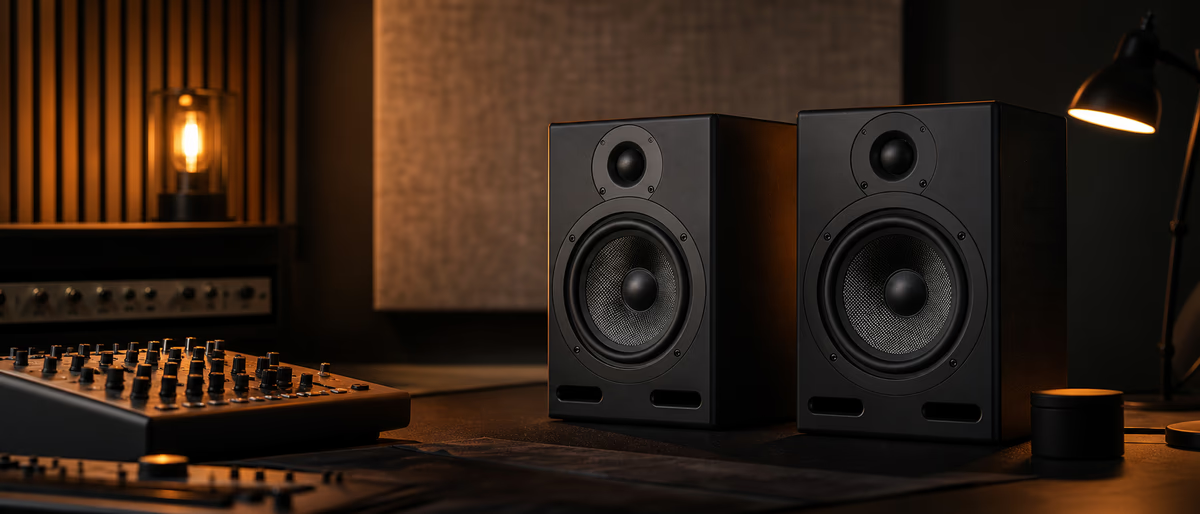
Under $500 per pair, pick honest nearfields that fit your room (often 3–5" for tiny rooms), invest in placement and basic treatment, and learn one pair deeply. Placement + room beat a slightly “better” speaker jammed against a wall.
Nearfields Under $500: Realistic Expectations
Entry studio monitors from established pro-audio brands can absolutely produce release-ready mixes when the room and engineer cooperate. They will not reproduce infinite sub like a club stack; use a sub only if the room can handle it—and most bedrooms cannot without treatment.
Budget pairs often live in the 3–5" woofer class for small rooms, with some 6–8" options if you have distance and acoustic control. Bigger is not automatically better in a 2.5 m wide bedroom; excited room modes will lie about bass.
As of 2026, shortlist lines from brands like Yamaha, JBL, KRK, Kali, PreSonus, Adam (entry), and similar—verify current model specs and pair pricing on manufacturer or authorized dealer pages.[1]
How to Choose Within the Budget
- Room size first Tiny untreated room → smaller woofers + headphones cross-check.
- Listening distance Nearfields are designed for desks, not couches across the room.
- Inputs Balanced TRS/XLR from your interface preferred.
- Rear ports vs front Rear ports need space from walls; front ports more forgiving near walls.
- EQ room switches Desktop/wall filters help—use carefully after placement.
- Noise floor Audible hiss at mix levels is fatiguing; check reviews for hiss notes.
Buy matched pairs. Avoid mixing random left/right from different generations. If buying used, test both speakers with mono pink noise for level matching and rattle.
Placement Checklist (Non-Negotiable)
If the desk forces bad geometry, prioritize stands behind the desk even if the setup looks less “RGB streaming ready.” Sound first, stream aesthetic second.
Monitors + Headphones as a System
Use monitors for balance and musical decisions; use headphones for clicks, noise, and late-night work. When they disagree, check mono, check reference tracks, and check whether the room bass is lying.
Build a short reference playlist and play it every session start to recalibrate. Commercial masters teach your monitors faster than static frequency charts.
True-peak and LUFS checks still happen in the DAW; monitors do not replace metering for streaming delivery targets.[2]
Room First, Then Upgrade Speakers
A $300 pair in a treated/symmetrical setup often beats a $500 pair in a reflective cave. If your budget is either better speakers or first reflection panels, many bedrooms should buy treatment first if speakers are already “okay.”
Clap test for flutter echo; add absorption. Bass trapping helps monitor truth more than buying a sub that doubles the problem.
Common Buying Mistakes
Choosing consumer Bluetooth bookshelf speakers marketed with “studio” in the Amazon title. Needing RGB VU meters more than linear response. Expecting hyped KRK-or-similar bass curves (model-dependent) to be neutral without learning their personality. Returning speakers without giving your brain a week to adapt while using references.
Also: running monitors insanely loud to “hear the sub.” Ear fatigue destroys mix judgment and hearing health. Moderate levels, longer careers.[3]
Practice Plan: Best Studio Monitors Under $500
Convert this guide into action within seven days. Block two calendar sessions labeled “Best Studio Monitors Under $500 only,” silence chat apps, and implement a single measurable change—one setting, one layout, one template, or one outreach script—rather than half-doing five ideas.
Document before/after with a bounce, screenshot, or checklist tick. If nothing measurable improved, revert and try the next highest-leverage tip from the comparison tables above. Progress is a loop of test → note → keep/discard.
Teach the improved method to a peer or future-you via a short note in the project folder. Explaining the workflow exposes gaps faster than rereading marketing pages. Then ship a finished track using the updated system so the learning sticks to real music.
Practice Plan: Best Studio Monitors Under $500
Practice Plan: Best Studio Monitors Under $500
Practice Plan: Best Studio Monitors Under $500
Monitors tell the truth about your samples—browse packs that hold up on real speakers.
Learning path
İlgili answer hub’lar
İlgili katalog
Katalogdan daha fazlası software
Katalog popülerliğine göre sıralanmış, Plugg Supply akışından daha fazla software.
İlgili makaleler
![EDM Ghost Production Phantomic v1.1.1 [WiN]](/images/posts/edm-ghost-production-phantomic-86114.avif?v=2026080101)
![Nico Baran The Motel v1.0.0 [WiN]](/images/posts/nico-baran-the-motel-86085.avif?v=2026080101)
Yazılım
En iyi %5Nico Baran The Motel v1.0.0 [WiN]
![Alpha Labs De-Feedback V1 v1.1.4 [MacOSX]](/images/posts/alpha-labs-de-feedback-v1-86113.avif?v=2026080101)
![DiscoDSP Corona v7.1.0 [WiN]](/images/posts/discodsp-corona-86083.avif?v=2026080101)
Yazılım
DiscoDSP Corona v7.1.0 [WiN]
![Tweakbench Noemi v1.0.1 [MacOSX]](/images/posts/tweakbench-noemi-86111.avif?v=2026080101)
Yazılım
Tweakbench Noemi v1.0.1 [MacOSX]
![Nico Baran The Fixers v1.2.4 [WiN]](/images/posts/nico-baran-the-fixers-86082.avif?v=2026080101)
Sık Sorulan Sorular
- Is $500 enough for serious monitors?
- Yes for nearfield bedroom mixing when paired with placement and basic treatment.
- 3" or 5" or 8"?
- Match room size; smaller rooms often do better with smaller woofers plus headphone sub checks.
- Do I need a subwoofer?
- Usually not at first in small rooms.
- Active vs passive?
- Budget nearfields are almost always active (powered)—keep it simple.
- Can I mix without treatment?
- Yes with care and multi-system checks; treatment still helps a lot.
- Are used monitors safe?
- If tested for noise, balance, and damage—yes, often great value.
- Monitors or headphones first?
- Headphones first in untreated shared spaces; monitors when placement is possible.